
| Bridge dimension (W x L) | (70 x 250) mm x 2 (90 x 250) mm x 2 |
| Cell membrane dimension (W x L) | 70 x 90 cm |
| Buffer capacity | 1000 mL |
| Thickness of cellulose acetate membrane | < 1 mm |
| Dimensions (L x W x H) | 350 x 260 x 65 mm |
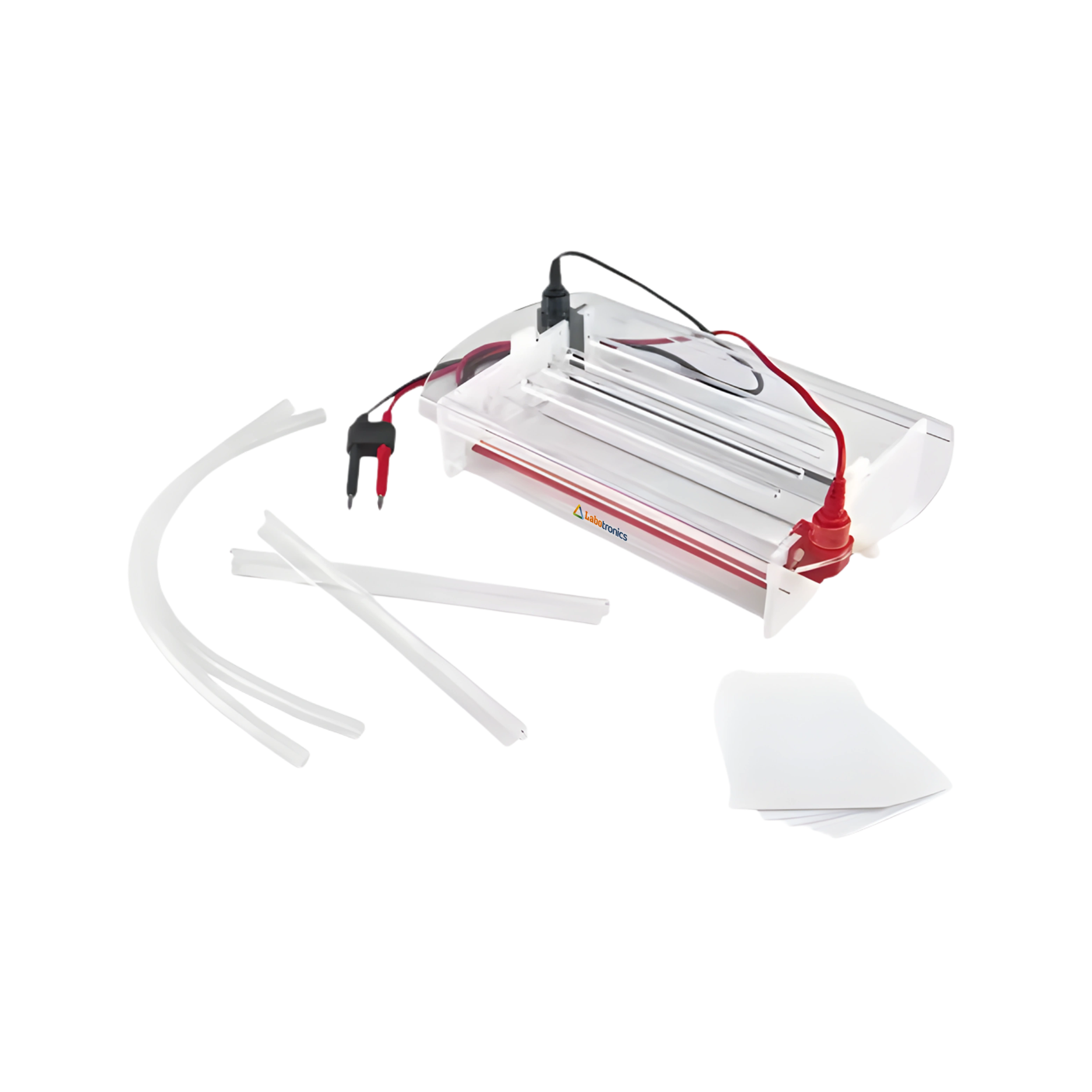
| Bridge dimension (W x L) | 66 x 250 mm 82 x 250 mm |
| Cell membrane dimension (W x L) | 70 x 90 cm |
| Buffer capacity | 560 mL |
| Thickness of cellulose acetate membrane | < 1 mm |
| Dimensions (L x W x H) | 318 x 175 x 65 mm |
Frequently asked questions For Cellulose Acetate Membrane Electrophoresis unit
1. How does cellulose acetate membrane electrophoresis work?
Labotronics cellulose acetate membrane electrophoresis unit works by applying an electric field to a cellulose acetate membrane saturated with buffer, causing charged molecules such as proteins or hemoglobin to migrate and separate based on their mobility.
2. What are the advantages of using cellulose acetate membranes?
Our Cellulose acetate membranes provide rapid separation, minimal sample requirement, high resolution, and easy staining/destaining for clear visualization of results.
3. Can the unit be used for clinical diagnostics?
Yes, our unit is widely used in medical laboratories for clinical diagnosis, particularly in testing hemoglobin disorders, liver diseases, and serum protein abnormalities.
4. How is the sample applied to the cellulose acetate membrane?
Samples are applied using an applicator or template to ensure precise loading and reproducible separation during electrophoresis.
Still have questions?
If you cannot find answer to your question in our FAQ, you can always
contact us. We will answer shortly!

Address: Labotronics Scientific. 1007 N Orange St.,
Wilmington, DE 19801, USA
Mail: info@labotronics.com
WhatsApp: +1 579 401 0534
All Sections
Best Seller
Quick Links
Copyright © Labotronics Scientific 2026