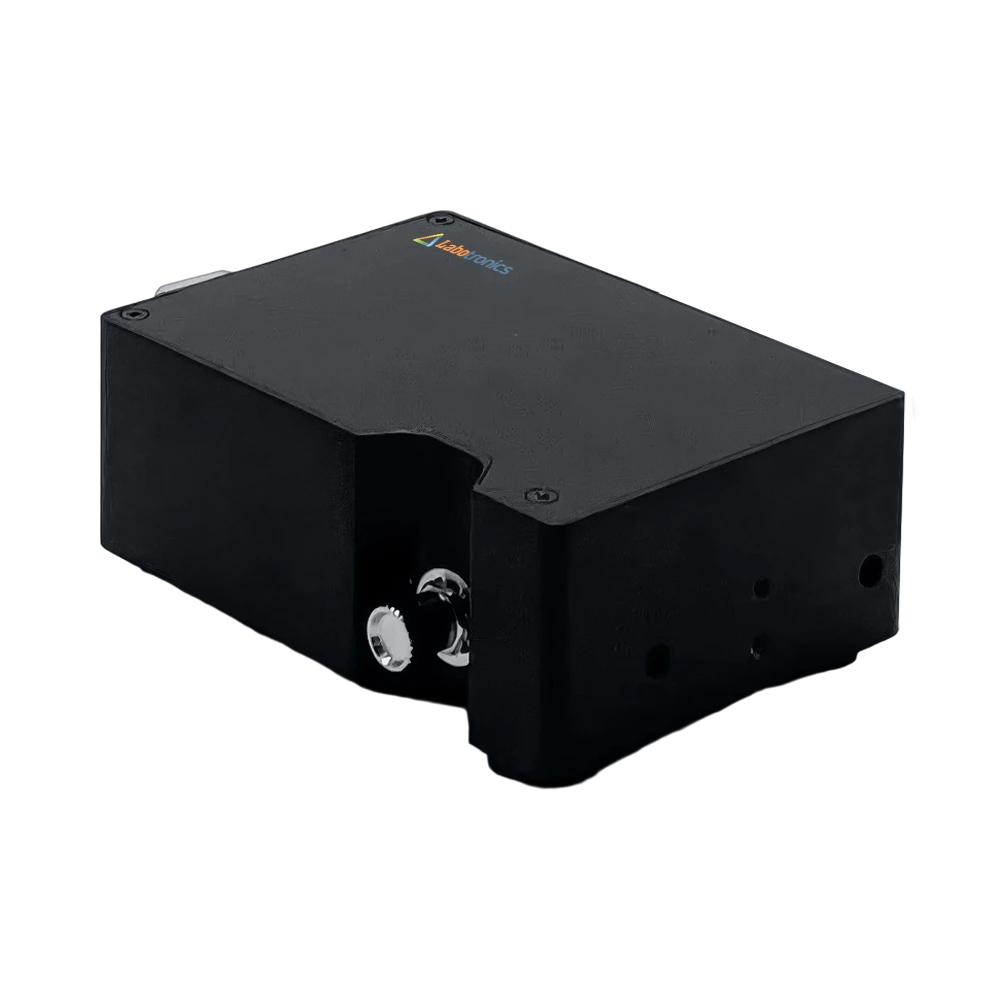


Fiber Optic Spectrometer LB-11FOS has a wide wavelength range of 200 to 1100 nm for versatile spectral analysis. It has a 3648-pixel detector, ensuring enhanced sensitivity and finer spectral resolution. It features an integrated optical bench to ensure precise alignment and long-term durability. Our spectrometer has a clear digital display for real-time spectral data monitoring.
$ 3162.5
Download CatalogSpecifications
| Wavelength Range | 200 to 1100 nm |
| Optical Resolution | < 0.75 nm |
| Sensitivity | 130 photons/count at 400 nm 60 photons/count at 600 nm |
| Corrected Linearity | > 99.8% |
| Signal-to-Noise Ratio | 300:1 |
| Stray Light | < 0.05 % at 600 nm < 0.10 % at 435 nm |
| Integration Time | 4 ms to 10 s |
| Detector | 3648 pixels |
| Pixel Size | 8 µm × 200 µm |
| Fiber Optic Connector | SMA905 to 0.22 NA single-strand fiber |
| Entrance Aperture Options | 5, 10, 25, 50, 100, 200 µm |
| Optical Design | Symmetrical Czerny-Turner |
| Focal Length | 101.6 mm |
| Trigger Modes | 2 types |
| Power Supply | 450 mA at 5 VDC |
| Connector | 30-pin connector |
| Dimension | 149 × 105 × 46 mm |
| Net Weight | 840 g |
Features
High signal accuracy
Fast scan speed
User-friendly software interface
Multiple grating options
Quick data acquisition
Low noise performance
Standard Accessories
Software
Optional Accessories
1.0/1.5/2.0 m 400 µm fiber
400 µm fiber holder
SMA905 or FC/PC 400 µm fiber
Applications
Fiber Optic Spectrometer LB-11FOS is used for laser and fluorescence spectral analysis, chemical testing, medical diagnostics, and film thickness measurement. It is used in research laboratories, medical facilities, and optical analysis environments.

Frequently asked questions For Fiber Optic Spectrometer
1. How does the wide wavelength range of Labotronics LB-11FOS enhance its usability?
Labotronics Fiber Optic Spectrometer LB-11FOS offers a broad spectral range that covers ultraviolet, visible, and near-infrared regions, making it suitable for a wide variety of scientific and industrial applications.
2. Can the Labotronics LB-11FOS be used for thin film measurements?
Yes, the LB-11FOS can analyze interference patterns within reflected or transmitted light, making it suitable for accurate thin film thickness evaluation in materials and semiconductor research.
3. What makes the Labotronics Fiber Optic Spectrometer LB-11FOS ideal for medical diagnostics and fluorescence studies?
Labotronics Fiber Optic Spectrometer LB-11FOS offers high sensitivity and low noise detection, making it ideal for fluorescence analysis and biomedical diagnostics.
4. What is the primary use of a Labotronics Fiber Optic Spectrometer?
Labotronics Fiber Optic Spectrometers are used for precise spectral analysis of light, enabling accurate identification and quantification of materials in scientific and industrial applications.
5. How does a Labotronics Fiber Optic Spectrometer capture and analyze spectral data?
Labotronics Fiber Optic Spectrometers uses fiber optic probes to collect light from the sample and directs it through diffraction gratings, allowing the system to separate and measure specific wavelengths for detailed analysis.
6. Can Labotronics Fiber Optic Spectrometers be used for real-time monitoring?
Yes, our fiber optic spectrometers feature digital displays that allow real-time monitoring of spectral data during experiments, enhancing data accuracy and user control.
7. Are Labotronics Fiber Optic Spectrometers suitable for field applications?
Yes, Labotronics Fiber Optic Spectrometers feature a compact design and flexible fiber optic connectivity, making them ideal for both laboratory and field-based use in environmental, chemical, and biomedical studies.
Still have questions?
If you cannot find answer to your question in our FAQ, you can always
contact us. We will answer shortly!

| Wavelength Range | 200 to 1100 nm (optional, max. 650 nm span) |
| Optical Resolution | < 1.0 nm |
| Detector | 3648 pixels |
| Pixel Size | 8 µm × 200 µm |
| Signal-to-Noise Ratio | 300:1 |

| Wavelength Range | 200 to 1100 nm |
| Optical Resolution | Depends on grating mark density and slit size |
| Detector | 2048 pixels |
| Pixel Size | 14 µm × 14 µm |
| Signal-to-Noise Ratio | ~ 450:1 |

| Wavelength Range | 350 to 1100 nm |
| Optical Resolution | Depends on grating mark density and slit size |
| Detector | 2048 pixels |
| Pixel Size | 14 µm × 14 µm |
| Signal-to-Noise Ratio | ~ 450:1 |

| Wavelength Range | 200 to 1100 nm |
| Optical Resolution | < 0.75 nm |
| Sensitivity | 130 photons/count at 400 nm 60 photons/count at 600 nm |
| Corrected Linearity | > 99.8% |
| Signal-To-Noise Ratio | 300:1 |

| Wavelength Range | 350 to 1100 nm |
| Optical Resolution | < 0.75 nm |
| Sensitivity | 130 photons/count at 400 nm 60 photons/count at 600 nm |
| Corrected Linearity | > 99.8% |
| Signal-to-Noise Ratio | 300:1 |

| Wavelength Range | 350 to 1100 nm |
| Optical Resolution | < 0.75 nm |
| Sensitivity | 130 photons / count at 400 nm 60 photons/count at 600 nm |
| Corrected Linearity | > 99.8% |
| Signal-to-Noise Ratio | 300:1 |

Address: Labotronics Scientific. 1007 N Orange St.,
Wilmington, DE 19801, USA
Mail: info@labotronics.com
WhatsApp: +1 579 401 0534
All Sections
Best Seller
Quick Links
Copyright © Labotronics Scientific 2026