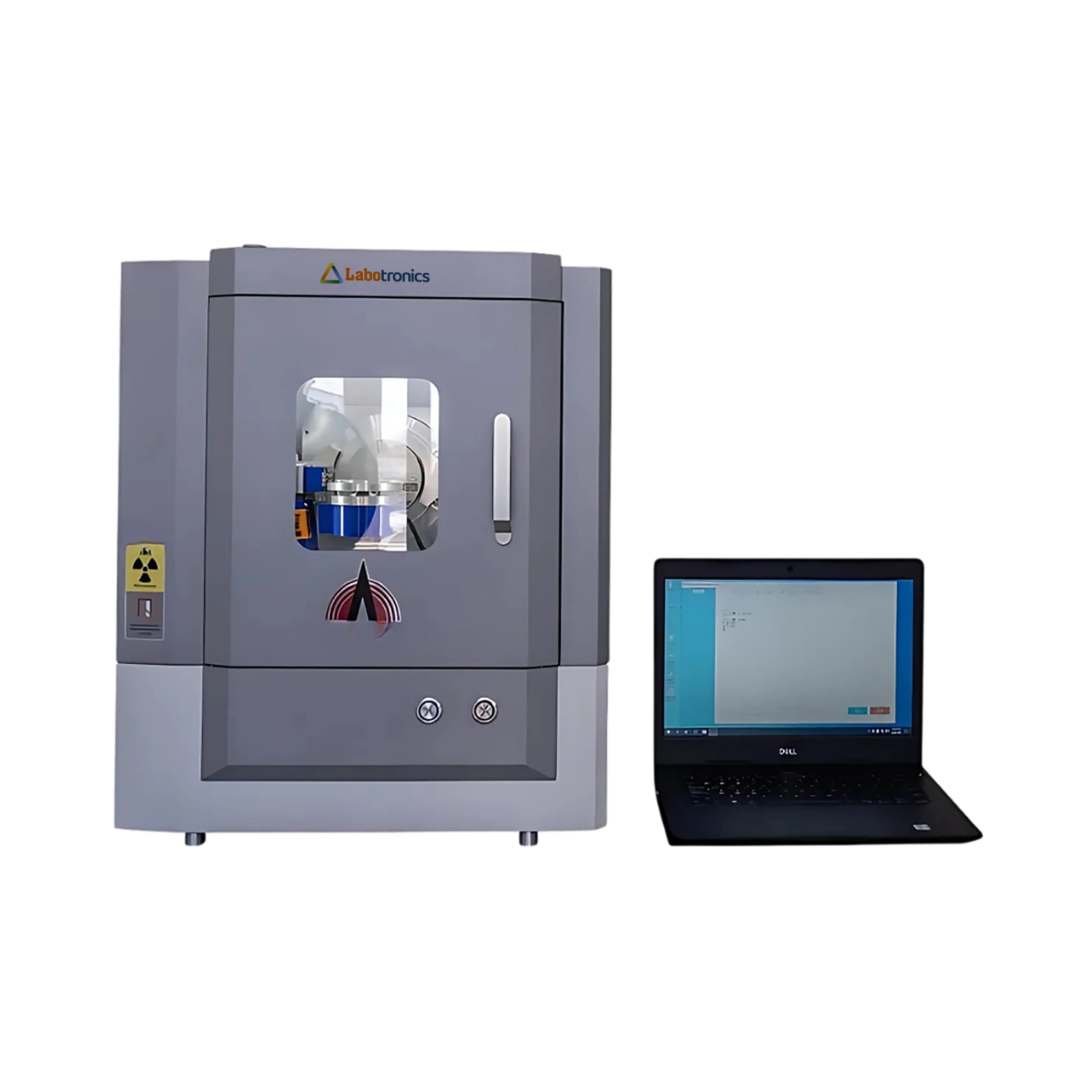
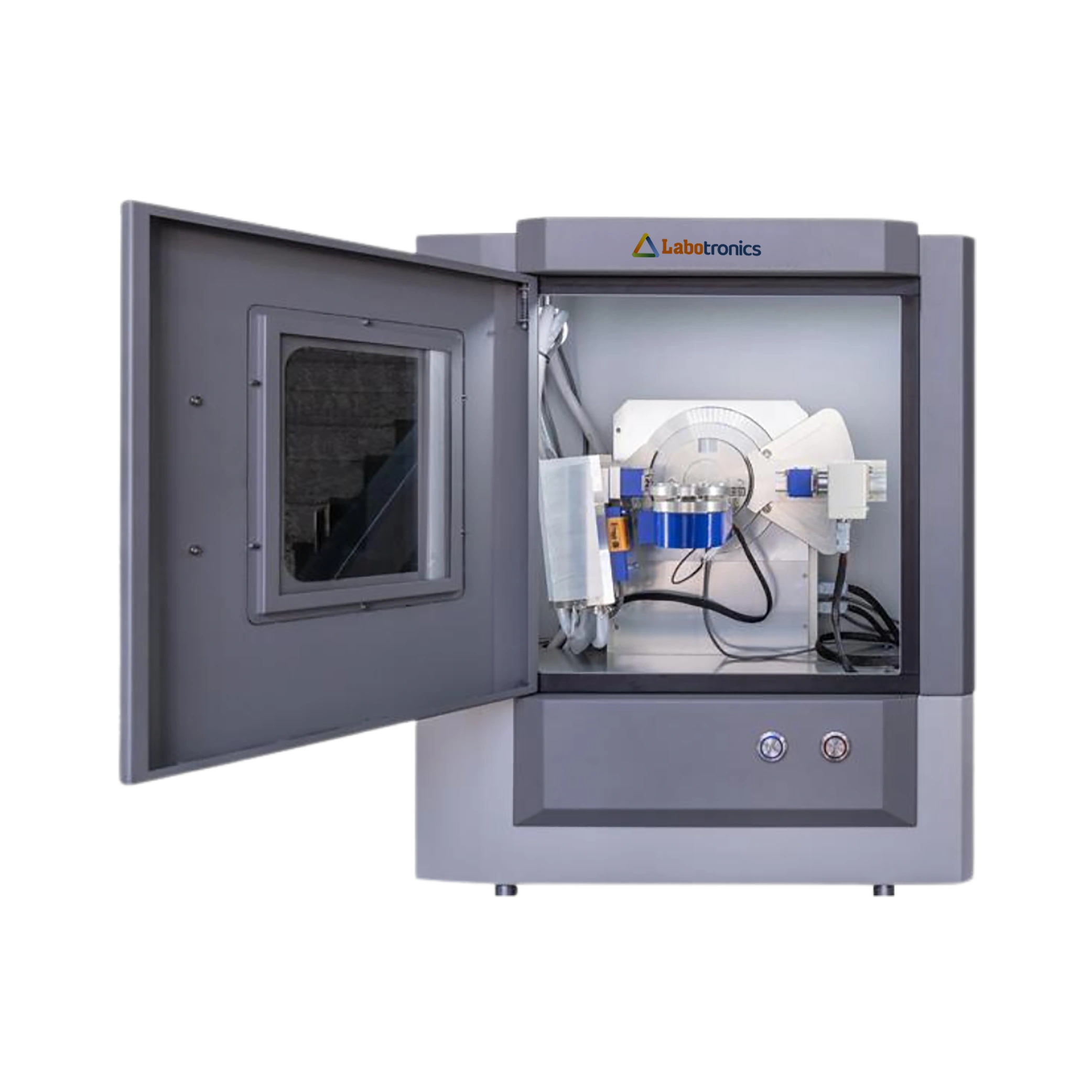
XRD Diffractometer LB-10XRD offers a wide angular range from -3° to 150° with an angle positioning speed of 1500°/min, ensuring precise crystallographic analysis. It features a metal-ceramic X-ray tube with a copper target for stable performance. It integrates servo motor drive with optical encoder technology for accurate motion control. Our XRD Diffractometer includes a high-precision goniometer, providing reliable measurements.
$ 60375
Download CatalogSpecifications
| Angular Range | -3° to 150° |
| Angular Reproducibility | 0.0001° |
| Angle Positioning Speed | 1500°/min |
| Measurement mode | Continuous / stepping |
| Drive mode | Servo motor with optical encoder control |
| X-ray Tube | Metal-ceramic |
| X-ray Source Material | Cu (Copper) |
| Focus Size | 1× 10mm |
| Stability | 0.005% |
| Maximum Counting Rate | ≥ 5×10⁵ cps |
| Energy Spectrum Resolution | ˂ 25% |
| Scattering Radiation | ≤ 1 μSv/h |
| Regulation Accuracy | ≤ 0.1% |
| Cooling Method | Air cooling / water cooling |
| Goniometer | θs to θd structure |
| Diffraction Radius | 150 mm |
| Tube Current | 15 mA |
| Tube Voltage | 40 kV |
| Rated Power | 600 W |
| Power Consumption | 2.4 kW |
| Inner Dimension (W × D × H) | 600 × 410 × 670 mm |
| Outer Dimension (W × D × H) | 785 × 570 × 1340 mm |
| Net Weight | 145 kg |
| Gross Weight | 160 kg |
Features
Lead shielding and shutter safety
Dual cooling modes
Fast angle positioning speed
High data throughput capacity
User-friendly interface
Standard Accessories
XRD Shell × 1 set
Tube Sleeve × 1 pc
Generator × 1 set
Recording and Controlling Unit × 1 set
Power Supply Unit × 1 set
Goniometer × 1 set
High Voltage Cable × 1 pc
X-ray Tube × 1 pc
Proportional Detector × 1 set
Motor Cable × 2 pcs
Communication Cable × 1 pc
Power Sample Stage × 1 set
Bracket × 1 pc
Slits × 13 pcs
Ni Filter × 1 pc
Through-hole Sample Plate × 10 pcs
Blind Hole Sample Plate × 20 pcs
Zero Adjustment Part × 1 pc
Fine Slit × 1 pc
Clamp × 15 pcs
Ribbon × 25 pcs
Clay × 1 pc
USB Flash Disk × 1 pc
Certificate × 1 pc
1A 1.5A 2A 6A Fuse × 1 set
Agate Mortar × 1 pc
Tool Package × 1 set
Laptop × 1 set
Strip × 1 pc
Steel Ruler × 1 pc
XRD Legs × 4 pc
Si Sample × 1 pc
Water Pipe × 1 pc
Alarm Light × 1 pc
Applications
XRD Diffractometer LB-10XRD is used for qualitative, quantitative, and crystal structure analysis of both metallic and non-metallic samples. It is suitable for use in industrial production, quality control, research and pharmaceutical applications.

Frequently asked questions For XRD Diffractometer
1. What types of samples can be analyzed using the LB-10XRD?
The XRD Diffractometer LB-10XRD can analyze powders, thin films, bulk materials, and polycrystalline samples, making it suitable for metals, ceramics, minerals, polymers, and pharmaceutical compounds.
2. What is the advantage of using LB-10XRD in material analysis?
Labotronics LB-10XRD provides rapid, non-destructive, and precise identification of crystalline phases, making it highly reliable for quality control, research, and advanced material characterization.
3. Does the LB-10XRD support quantitative as well as qualitative analysis?
Yes, our LB-10XRD provides both qualitative phase identification and quantitative phase analysis, helping researchers determine material composition and relative phase proportions.
4. What is an XRD Diffractometer used for?
Our XRD Diffractometer analyzes crystalline structures, identifying phase composition, crystallite size, lattice parameters, and material purity across various industries.
5. How does an XRD Diffractometer work?
Labotronics XRD works by directing X-rays at a crystalline sample and detecting diffracted rays at specific angles to generate a pattern that reveals the material’s structure.
6. What are the advantages of XRD analysis?
Our XRD Diffractometer provides non-destructive, precise analysis by identifying compounds, determining crystallinity, and quantifying phases without damaging the sample.
7. What are the limitations of XRD analysis?
XRD is limited to crystalline materials and is less effective for amorphous substances or very small/complex samples, which may need advanced techniques.
Still have questions?
If you cannot find answer to your question in our FAQ, you can always
contact us. We will answer shortly!

Address: Labotronics Scientific. 1007 N Orange St.,
Wilmington, DE 19801, USA
Mail: info@labotronics.com
WhatsApp: +1 579 401 0534
All Sections
Best Seller
Quick Links
Copyright © Labotronics Scientific 2026